




A secondary crash is one where, say, you get rear-ended in stop-and-go-traffic on the highway. That causes your automobile to be pushed into the adjoining lane, where traffic is moving faster. Then, someone barrels into the side of your automobile, since you were shoved into that lane. Yep, that may be very bad.
A secondary crash may also be brought on by someone not obeying the move-over law, meaning, a crash has already taken place, the cars are already off on the shoulder, and EMS or a tow-truck is attending to that accident. The secondary crash is a driver barreling into an individual attending to those folks. This can also be terrible and means the towing industry is one among the deadliest types of employment within the country.
Fortunately, most secondary accidents, in keeping with a 2023 Federal Highway Administration study, are non-fatal. The administration examined 5,461,044 primary crashes across 10 states. It sorted through all of those accidents, then checked where the states had reported secondary crashes. Researchers tried to prove the secondary wrecks occurred on the identical route, inside a detailed timeframe and inside a couple of mile of the particular primary accident, since it is not an actual secondary accident if it didn’t coincide with the primary crash. That evaluation showed that only 15,488 secondary crashes resulted from those primary crashes. Because of this secondary crashes are incredibly rare. No state studied had a rate higher than .81 crashes per primary wreck.
Plus, one among the study’s most important conclusions was that “A lot of the secondary crashes (71%) involved no apparent injury, and lower than 1% of the secondary crashes involved fatal injuries.” That said, there are contributing aspects that could make even that rare secondary accident much more severe, like higher speeds, the involvement of huge trucks, or fewer lanes.
Speed kills, and so do trucks
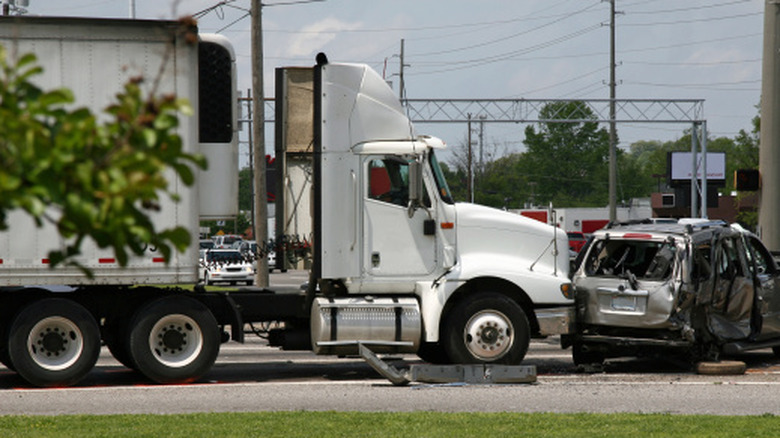
It isn’t hard to grasp that a automobile accident, or a secondary accident, involves kinetic energy. Or, simply, speed kills. A 2020 study published by the International Journal of Environmental Research on Public Health found that raising speed limits may cause more deadly accidents. Every 1% increase within the speed limit increased the probability of a severe secondary crash by 2.6%. The researchers attribute this not only to the obviousness of all that added force, but additionally to reduced response times for drivers.
But there’s one other factor to think about: traffic. Each this study, and a separate, 2019 article within the journal, Physica A, show that higher traffic volume is rather more more likely to result in secondary accidents. Each of the previous studies checked out Chinese traffic. That may very well be different from American traffic. Nevertheless, a 2025 study from the Eastern Transportation Coalition, which eyeballed secondary accidents in Maryland, Virginia, Tennessee, and Florida, also found that more traffic drove up the prospect you may get right into a secondary accident. Researchers found a roughly 5% to six% odds increase for a secondary collision, based on data for Virginia and Florida, though only a 2.5% odds increase in Maryland. Still, more volume equals more secondary pileups.
And there is one other risk, which is what happens when an 18-wheeler is involved within the traffic accident. While limited to only the aforementioned study within the International Journal of Environmental Research on Public Health, when a truck is in the combo of a secondary accident, the final result for anyone in a passenger automobile is much more more likely to be severe.
More lanes and wider shoulders result in fewer secondary crashes
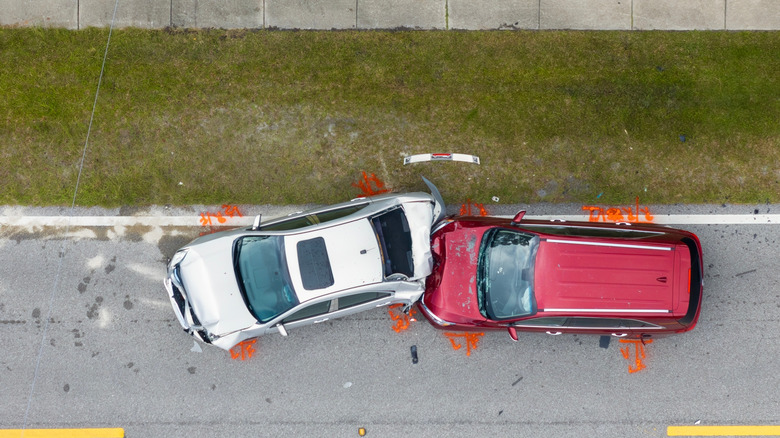
You do not have to be a genius to know that, sometimes, you actually shouldn’t do “your personal research.” Legitimate science requires rigor. But within the case of what reduces secondary crashes, common sense makes the formula relatively straightforward. And research bears that out. A 2017 study within the journal, Accident Evaluation & Prevention, found that a broader shoulder is safer, not only for EMS personnel attending to accidents, but additionally for reducing the likelihood of secondary crashes. And there is a knock-on effect that is related, too, which is that wider roadways with more lanes are safer.
Again, that is pretty logical. Consider a divided highway. If there are two lanes in each direction, an accident in one among those lanes suddenly reduces the carrying capability by 50%. But with three lanes in the identical direction you have only lost a 3rd of the capability. On a three-lane highway, in case you’re just behind that accident, you likely have more options to avoid piling into the crash ahead of you.
The aforementioned study found that roads with more lanes see fewer secondary crashes: Two-lane highways had 73% more secondary crashes than roads with three or more lanes. A 2014 Journal of Safety Research study of the Latest Jersey Turnpike found that closing multiple lane of traffic increased the chance of a secondary crash by a reasonably terrifying 4.8 times. That may be a yikes statistic that ought to encourage you to at all times heed the life-saving three-second buffer driving rule.
This Article First Appeared At www.jalopnik.com
