




Porsche won’t produce petrol-powered versions of its upcoming electric 718 successor in spite of everything, but it’ll construct a brand new mid-engined, combustion-powered hypercar.
The German automaker had confirmed in September 2025 it will add “top ICE [internal combustion engine] derivatives for brand spanking new 718”, amongst other future product plans which included a petroleum and plug-in hybrid (PHEV) mid-size SUV to more directly replace the previous Macan, and a brand new flagship SUV that may be launched with petrol and PHEV power.
But these petrol-powered 718 Boxster and Cayman models don’t appear within the German brand’s recent strategy announced this week, dubbed Sportwagenschmiede ‘35, which outlines only electric versions due in 2027.
Motor1 reports word from Porsche’s corporate communications boss, Matthias Rauter, who said the ICE 718 derivatives were never actually confirmed for a comeback.
As for the Mission S hypercar concept, Porsche says it’ll “provide a preview of a possible mid-engined super sports automotive platform” on October 15.
It has released a brief teaser video, though it shows little besides a pair of 911-like headlights.
Unlike previous Porsche concepts with the Mission name – the 2015 Mission E, which previewed the Taycan, and the 2023 Mission X, an electrical hypercar – the Mission S appears set to feature a combustion engine.
Indeed, Porsche has watered down its EV goals, which as recently as 2024 called for battery-electric vehicles to account for greater than 80 per cent of its sales by 2030. Now it now has a mid-term ambition of ICE and PHEV vehicles to outnumber EVs by two-to-one.
Elsewhere within the Porsche lineup, the aforementioned petrol/PHEV mid-size SUV prone to share its platform with the Audi Q5 will likely be launched in 2028 and offered alongside the electrical Macan.
Individually, Porsche now says it’s merely “exploring the chance” of an extra-large SUV to sit down above the Cayenne, despite such a model seemingly being a done deal. As mentioned before, this can support petrol, PHEV and electric power.
Across the broader lineup, Porsche is targeting a 20 per cent reduction in model variants, which it believes will increase the sales volume per model variant by about 30 per cent within the medium term.
It’s also placing greater deal with its dearer models – those within the so-called D/E segments, including the 911 and Panamera – with the medium-term goal of accelerating their share of total Porsche sales by 45 per cent. They currently account for around 32 per cent of its sales.
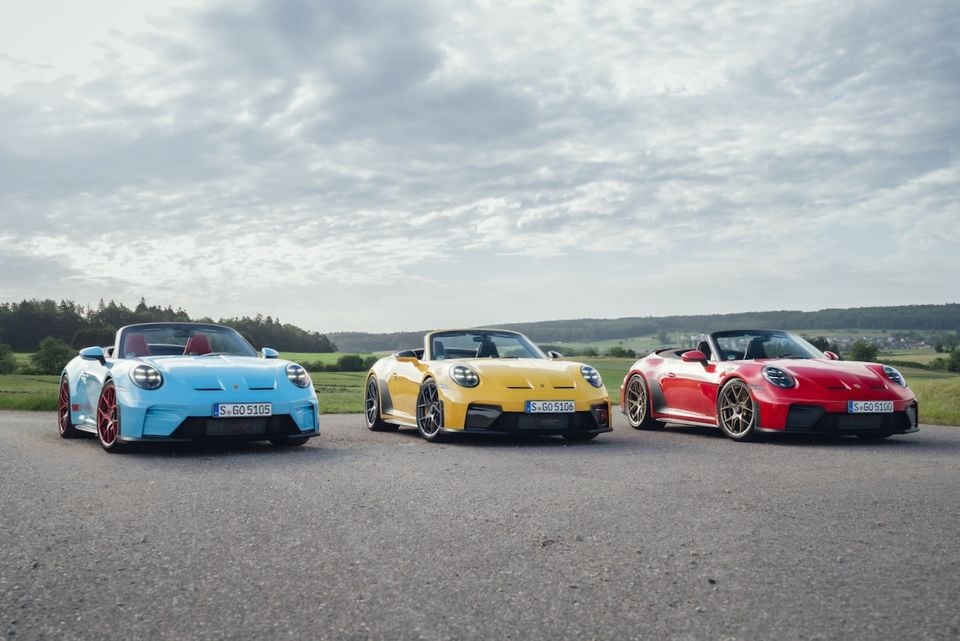
For context, Porsche splits up its current and upcoming models across 4 segments: B+, comprising the 718 and Macan; C, consisting of the Taycan and Cayenne; D, denoting the 911, Panamera and the proposed flagship SUV; and E, for the upcoming hypercar.
Porsche’s revised strategy, developed under recent CEO (and former McLaren boss) Michael Leiters, is meant to show the brand around after its operating income fell 93 per cent in 2025 amid weak demand in China and tariffs within the US.
It’s aiming for a 10-15 per cent return on sales within the medium term (with a strategic long-term goal of 15 per cent), in comparison with 1.1 per cent in 2025, while lowering its break-even point to 200,000 annual units. Porsche sold 279,449 vehicles worldwide last 12 months, compared with 310,718 in 2024, and 320,221 in its record sales 12 months of 2023.
Cost-saving measures will include a 20 per cent reduction in sales and distribution costs, and a 40 per cent reduction in management positions within the mid-term, plus a ten per cent reduction in individual material costs for brand spanking new vehicle projects.
This Article First Appeared At www.carexpert.com.au
