




The Denza D9 is ready to receive a big update in Malaysia, with the local arm teasing the newest model on its socials. No details have been revealed just yet; the automobile within the glitzy video looks all of the world like the prevailing luxury electric MPV, so there’s nothing to be gleaned there.
We will, nevertheless, surmise that there are two distinct possibilities here. The primary is that the plug-in hybrid DM-i version is making its way here, three months after being introduced in Europe and the UK. This adds a 120 PS/220 Nm 1.5 litre turbo four-cylinder engine, paired with less powerful dual motors – 231 PS (170 kW) on the front and 61 PS (45 kW) on the rear.
While the electrical motors perform the overwhelming majority of the automobile’s propulsion, the combustion mill may also clutch in to assist drive the front wheels at higher speeds, leading to a complete system output of 353 PS (260 kW) – still 21 PS (15 kW) lower than the AWD version of the EV.
So equipped, the D9 DM-i can get from zero to 100 km/h in 8.6 seconds on its strategy to a top speed of 180 km/h. Juicing the electrical motors is a 58.5 kWh Blade LFP battery for a pure electric range of 210 km on the WLTP cycle.
Combined with the 61 litre fuel tank, this provides the automobile a complete range of 950 km – addressing the EV’s not-so-stellar range, a serious gripe we had with the all-wheel-drive version. With support for BYD’s Flash Charging tech at as much as 559 kW, the DM-i is capable of be topped up from 10 to 70% in five minutes and to 90% in nine minutes.
The opposite, more likely possibility is Malaysia marking the worldwide debut of the refreshed electric D9, which was introduced in China earlier this yr. This brings a comprehensive update to the mechanicals that will help the automobile overhaul rivals just like the Zeekr 009 and Xpeng X9.
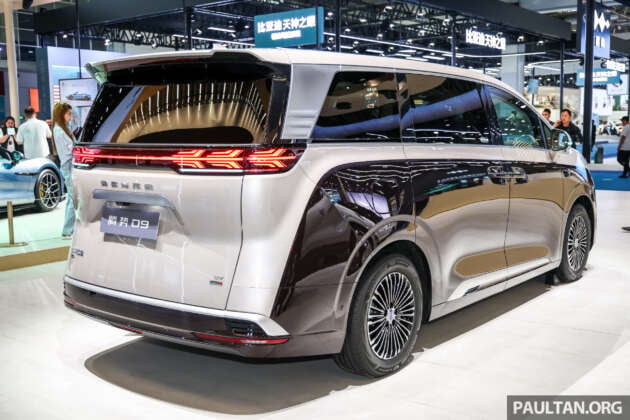
First, the additional power – even the front-wheel-drive version makes a stout 462 PS (340 kW) and 365 Nm of torque, up from 313 PS (230 kW) and 360 Nm before. The AWD variant adds a 95 PS (70 kW) rear motor for a complete output of 557 PS (410 kW), a rise of 183 PS (135 kW).
The D9 also gains BYD’s second-generation Blade LFP battery, with a minor capability bump from 103 kWh to 115 kWh. This leads to a lift in range to 800 km on China’s lenient CLTC cycle for the FWD version and 750 km with AWD. Expect WLTP figures closer to 680 km and 640 km respectively, which might still be an enormous improvement over the present figures of 520 km and 480 km respectively.
Much more significant is the sharp increase in DC fast charging power, with the brand new battery also enabling Flash Charging technology, this time at the complete 1,500 kW. That’s a world away from the previous maximum of 166 kW, and which means it can also charge from 10 to 70% in only five minutes and to 97% in nine minutes.
What we are able to ensure of is irrespective of which version involves Malaysia, the D9 will gain Flash Charging support – not surprising on condition that there was a variety of hubbub surrounding its local deployment of late. As yet, the one BYD-built automobile to support the system here is the Z9GT, and the addition of a more mainstream, inexpensive model would broaden access to those chargers’ full capabilities.
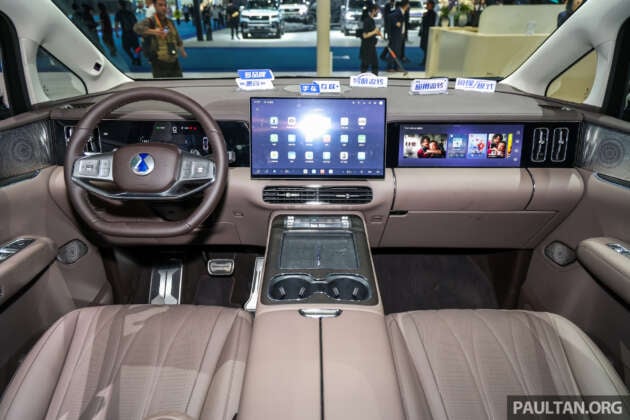
The mechanical makeover coincides with a serious interior redesign, with a cleaner horizontal dashboard design giving the automobile a far more upscale air. Although the ten.25-inch instrument display and 15.6-inch “floating” infotainment touchscreen remain unchanged, the revamp adds one other 15.6-inch touchscreen for the passenger, at the least for the Chinese market.
Elsewhere, there are actually twin vertical air vents on the corners of the dashboard and sleeker rectangular centre vents. Meanwhile, the flying buttress centre console now houses twin Qi wireless chargers (just the one previously) and what seem like physical air-con controls.


To unlock space for all this stuff, the crystal gear selector has been ditched in favour of a column-mounted shifter that’s all the fashion in China lately. There’s also a brand new two-spoke steering wheel, and while the seven-seater layout and the plush powered, heated, ventilated and massaging second-row captain’s chairs remain, there’s finally a 17.3-inch ceiling monitor.
No changes to the outside, save for the EV ditching its vertical grille strakes for the PHEV’s flag-shaped inserts. We’ll know more concerning the latest D9 fairly soon, but for now, which might you favor to see in Malaysia – the PHEV, or the updated EV?
GALLERY: Denza D9 EV update at Auto China 2026
This Article First Appeared At paultan.org
